Let's talk about totally normal, uncontroversial things like Google AI, arguing with educated people on the internet, and premarital sex.
Somebody picked up a really old thread of mine on Threads and made a bunch of claims that are wrong. The first was that God defines marriage as between a man and a woman in Genesis 2.
No. The word "marriage" doesn't show up in the Hebrew Bible. The closest thing is the word for "wedding," חֲתֻנָּה (hatunnah), and it shows up once, in Song of Songs 3:11. There are idioms and euphemisms for marriage, but the Bible never gives us a definition of it, much less in Genesis 2.
A man "takes" a woman. A father "gives" his daughter. In Deuteronomy 24:1, a man becomes a woman's בַּעַל (ba'al), her lord and owner. Genesis 2:24 says a man leaves his father and mother, clings to his wife, and they become one flesh. That's a story about why men and women are drawn to each other, and it defines precisely nothing. If it settled "one man, one woman," somebody forgot to tell Abraham, Jacob, David, and Solomon.
Sex before marriage
The second claim was that premarital sex is wrong. I replied with a statement that's just simply true, and won't surprise many people who've studied the Bible professionally: the Bible does not condemn premarital sex.
In some places it seems to understand that premarital sex is a thing that happens, and it doesn't seem all that upset about it. Judah sleeps with a woman he thinks is a prostitute (Genesis 38). Samson visits one in Gaza (Judges 16:1). The narrator shrugs both times. The biggest example is the Song of Solomon, eight chapters of two unmarried lovers sneaking around the city at night.
The rules that do exist are about property, and they fall—predictably—on women. A man who seduces an unengaged virgin owes her father the bride-price (Exodus 22:16–17). A bride whose husband claims she wasn't a virgin can be stoned at her father's door (Deuteronomy 22:13–21). That's a husband's claim on a woman's body, enforced with rocks. I don't think most at a purity-culture youth retreat want to preach that.
There also weren't marriage ceremonies, at least not the way we'd picture one. No officiant, no vows. Maybe a feast. A man brought a woman home, they had sex, and they were considered married. "Isaac brought her into his mother Sarah's tent," Genesis 24:67 says. "He took Rebekah, and she became his wife." Amazingly, our culture has swung all the way back around to that.
This person did not like that I said the Bible doesn't condemn premarital sex. So they replied with a screenshot of a Google AI Overview. I don't know what their prompt was. The Overview said the Greek word πορνεία (porneia) refers to fornication and sexual immorality, an umbrella term that includes premarital sex.
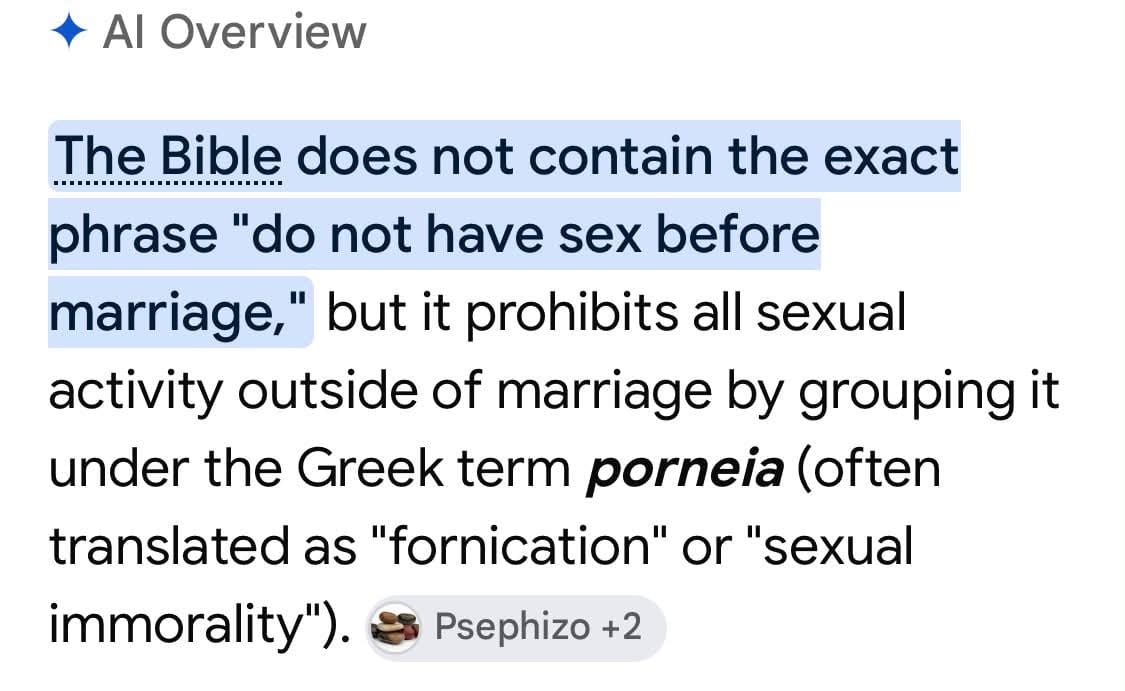
That little tag at the bottom is Psephizo, a blog by the conservative theologian Ian Paul, which argues that every New Testament warning about "sexual immorality" includes sex before marriage.
Quick aside: I'm not an anti-AI person. My main issue with AI is that our legal system has a shit ton of work to do to catch up to how AI interacts with copyright. That's not all that different from the '90s, when search engines and digital music and movies far outpaced the law, and the law had to figure out royalties and how to pay artists and creators fairly. I "produce artistic content" every week as a pastor and writer, and I'm not opposed to large language models existing.
The law also has to catch up on data centers, so we take care of the communities around them and don't waste tons of water. (Though if you really care about water usage, take a hard look at your ethanol-infused gasoline car. Corn ethanol takes somewhere between 10 and 324 gallons of water to make one gallon. Yes, we need to care about both things at the same time. Anyway.)
People love to dunk on how supposedly stupid AI is by posting screenshots of Google's AI Overview. That's a horrifically bad-faith way of showing what AI can do. Google users expect an instant answer, so the Overview is built for speed: a very, very quick summary of whatever the top search results say. Google itself says Overviews are "built to surface information that is backed up by top web results."
So if somebody types into the Google box, "Hey, I need to prove to this liberal progressive pastor online that the Bible condemns premarital sex. It does, right?" the Overview hands back a fairly uninformed answer. Which is what happened here.
I know their screenshot "proof" does not reveal what porneia means because, honestly, I'm simply more educated than the instant-AI answer. My studies in Greek, dozen exegesis classes, and shelf full of commentaries and lexicons—in this case—give me a better idea grasp of what we're talking about than a Google Overview. Again, it's possible—likely, in fact!—that a more sophisticated and resourced LLM could do better.
The Liberation and Inclusion Translation (LIT) renders porneia as "sexual exploitation," and its note on the word explains why:
Sexual immorality – porneia – sexual exploitation
The traditional rendering, “sexual immorality,” is vague, and that vagueness has been abused. It has been weaponized to cover anything related to sex that makes people with power uncomfortable. The Greek is more specific than that, and it refers to things the traditional term typically ignores and ignores things “sexual immorality” typically includes. Porneia shares a root with perneimi, which means “to sell.” Porne is the word for a female sex worker, who in that cultural context would always have been someone exploited and failed by a patriarchal society. In literature outside of Jewish and Christian writings, the word group was used exclusively for the commercial sex trade. Jewish and Christian writers seem to expand the meaning to refer to approaches to sex that objectify, abuse, and exploit people in a variety of ways. It would still have included sex work motivated by desperation, and among the community of people who followed Jesus, the guilt would have been not on the desperate women and girls but on those who should have taken care of them or abandoned them to their fate. So this is not primarily about failing to abstain from consensual but unsanctioned sex, such as between unmarried individuals or people of the same sex. It is about harming, exploiting, or abusing someone sexually. There is also a good case that for a first-century Jewish hearer it would point toward the sexual instruction in Leviticus 17 through 20, given how the Jerusalem Council uses it in Acts 15:20–21.
The male counterpart, a πόρνος (pornos), is, in the historian Kyle Harper's phrase, "a gigolo, not a john." Even the English word "fornication" comes from the Latin fornix, an arch, probably because Roman prostitutes worked under the arches.
Jewish writings from the centuries around Jesus stretched the word to cover all kinds of sexual immorality, and Christian writers from the second century on stretched it further, eventually to premarital sex. Most of those texts sit outside the Jewish and Christian canon. Whoever was using the word decided what porneia covered. The Dead Sea Scrolls used the Hebrew equivalent for polygamy. The book of Tobit applied porneia to lust between a husband and wife (8:7).
When Paul uses porneia, look at his examples: a man sleeping with his stepmother (1 Corinthians 5:1), a man joining his body to a prostitute (6:15), and desire that "wrongs or exploits" someone else (1 Thessalonians 4:6). The verb there, πλεονεκτεῖν (pleonektein), means to take advantage. All three involve a body being used or bought.
I'm not saying that no good scholars disagree with me. Smart people will argue that Paul "condemns all forms of nonmarital sex as sexual immorality," and 1 Corinthians 7:2 is the strongest text on their side. But I do think Paul's examples point somewhere else. Either way, the Overview is right that porneia became an umbrella term. But an umbrella covers whatever the person holding it decides to cover, and "porneia includes premarital sex" only tells you where later Christians held it and what conservative blogs Google slurped up and regurgitated back out. But it doesn’t tell you what the Bible actually says.
A couple of takeaways. First, I'm not opposed to using AI for research. But the Google AI summary box is the cheapest, dumbest form of research there is. Please don't come at your decently well-educated pastors online with it. It's bad form, and it makes you look stupid. If you want AI's help with the Bible, ask a research and thinking model a neutral question, like "What does porneia mean in Paul, and where do scholars disagree?"
Two. I'm not going to pretend there aren't lots of regressive ideas about sex and relationships in the Bible. Clearly there are. You only need to flip to the regulations on sex slaves and women captured in war (Exodus 21:7–11; Deuteronomy 21:10–14) to see that. But let's deal with the Bible as it is, and not make up things that aren't true. And one thing that isn't true is that the Bible treats premarital sex as wholly condemned and obviously wrong. It just doesn't.