"Let go and let God."
Hell of a bumper sticker, especially on a car, which is, like, a place where this advice is fatal. Same with "Jesus, take the wheel." Um, if you let go of the wheel at seventy miles an hour, Jesus does not take it. The median takes it, the insurance adjuster takes it. Whatever invisible force ends up steering your car, it will not have your best interests in mind.
We know this about driving so we probably shouldn’t forget it about everything else. According to “Let go and let God,” should we let go of the marriage, the job search, the school board election, the phone call we owe our senator, and call the resulting drift "trusting God"?
If anyone asks for a proof text, this verse shows up:
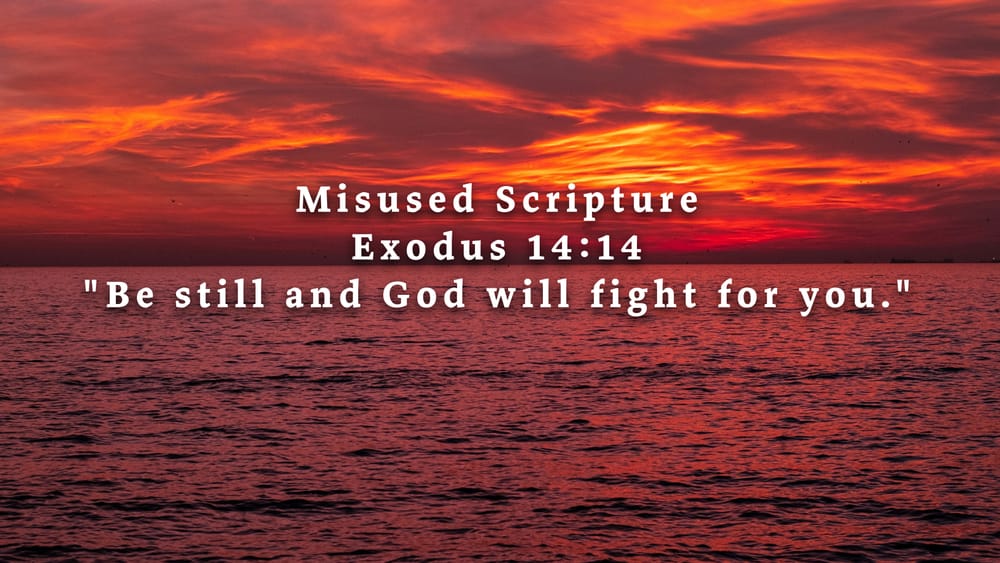
The LORD will fight for you; you need only to be still. (Exodus 14:14)
Like, if you dare name something is wrong with your life, I bet some well-meaning Christian will brandish this verse at you. So let's look at what it's actually doing in Exodus.
One verse. It lasts one verse!
Exodus 14 is when Israel is pinned in: Pharaoh's chariots behind them, the sea in front of them, and the people are screaming at Moses that there weren't enough graves in Egypt, so apparently they had to come die in the wilderness. (The freed people are being sarcastic with their liberator. Love it.)
Moses answers with verse 13: "Do not be afraid. Stand firm." The Hebrew is הִתְיַצְּבוּ (hityatzvu). It's battlefield language: take your stand, hold your position. What you would say to troops about to break ranks and bolt.
Then verse 14: "The LORD will fight for you, and you shall be silent" — תַּחֲרִשׁוּן (taharishun), often translated “still” in this verse. What Moses is really saying is “Stop wailing!” Moses is not describing a spirituality but steadying a panicking column of refugees who are about thirty seconds from running back toward the chariots.
Then God speaks: "Why do you cry out to me? Tell the Israelites to move forward."
The passive reading survives precisely one verse. Moses says be quiet/still; and God immediately says march. And notice verse 16: God doesn't part the sea while Israel watches from beach chairs. God tells Moses to lift his staff and stretch out his hand over the water. The sea splits through a commanded human gesture. The miracle is entirely God's, but it runs through a human arm.
"Let go and let God" is a good way to end up on the bottom of the sea or crushed by a chariot.
Part of the problem is that popular piety has fused two different verses into one "be still" spirituality, but they don't even use the same verb.
Psalm 46:10 — "Be still, and know that I am God" — uses הַרְפּוּ (harpu), from a root meaning to release, to drop, to let fall slack. And in context, it's addressed not to individuals but to the nations at war. Two verses earlier, God is breaking bows and shattering spears. It's a disarmament order. "Hey that spear in your hand? Drop it." Where as Exodus 14:14 uses חרש (harash): be silent. Stop screaming.
So the two great "be still" verses of Scripture say, respectively, put down your weapons and stop wailing, we're about to move. Neither one says "do nothing." Whatever we do, we can’t build a devotional aesthetic out of a mistranslated composite verse.
The rabbis got there first
The Talmud actually tells a story about this moment (Sotah 37a; the Mekhilta has a version too). While Israel stands at the water's edge, the tribes argue about who should go first. While they argue, a man named Nachshon ben Aminadav walks into the sea. The water reaches his knees, then his waist, then his chin. In the midrash, the sea doesn't split until the water touches his nostrils!
The interpretive tradition that knows this text best refuses the passive reading. In the rabbis' telling, the sea opens for the one already walking.
Christians have a version of this story too, out on the Sea of Galilee. Peter doesn't wait for conditions to improve; he asks to get out of the boat mid-storm. Who needs the sea to part when you can walk on top of it?
How the verse actually hurts people
I don’t think anybody intentionally preaches the misuse of Exodus 14:14. You likely won’t find a sermon titled "Five Easy Steps to Be a Passive Doormat." The misuse is more ambient, more about creating a culture of passivity.
It can sound like "just pray about it" to people in crisis. It can sound like "thoughts and prayers" after the eleventh school shooting of the year, as if prayer were designed to be a substitute for action rather than the engine of it. James has a word for spirituality like that: telling a shivering neighbor "go in peace; keep warm and eat your fill" while handing them nothing. He calls that faith dead (James 2:16–17).
It can sound like a pious text message. A woman finally tells a friend what's happening at home, and the friend responds: The Lord will fight for you; you need only to be still. Nobody explicitly told her to stay with the man hurting her, but nobody had to. The verse, misread, does that work all by itself. Jolene Underwood, writing at Crosswalk, documented how quoting this verse at people in crisis pressures them to "suck it up" and defer to a rescue that isn't coming through passivity. The abuse case is the extreme (but common!) instance of the malformation. Too many have been handed a faith trained to let life happen to them rather than participate in it.
Co-workers, not spectators
I believe that God's will for the world requires us. Thomas Jay Oord calls this "essential kenosis": God's love is uncontrolling all the way down, non-coercive by nature and not merely by policy, which means God doesn't accomplish things in the world by overriding creatures. God accomplishes things with them. Prayer matters in this framework. So do phone calls, casseroles, protest marches, and restraining orders. Grace runs through human arms. It did at the Red Sea.
Paul says it without embarrassment: we are συνεργοὶ θεοῦ (synergoi theou), God's co-workers (1 Corinthians 3:9).
"Work out your own salvation with fear and trembling, for it is God who is at work in you" (Philippians 2:12–13). Paul writes both halves in one breath and feels no need to choose between them.
Dallas Willard put it in his famous line: "Grace is not opposed to effort, it is opposed to earning."
None of this means hustling for the kingdom until you drop. Richard Rohr named his organization the "Center for Action and Contemplation" and likes to say the most important word in the name is "and."
There is a real stillness in this text. It's the stillness of verse 13: battlefield composure, standing firm while your pulse hammers, refusing to bolt back toward Egypt just because Egypt is familiar. We all need to keep that stillness. But the word that comes next is march. The Lord will fight for you, and you will still get wet.