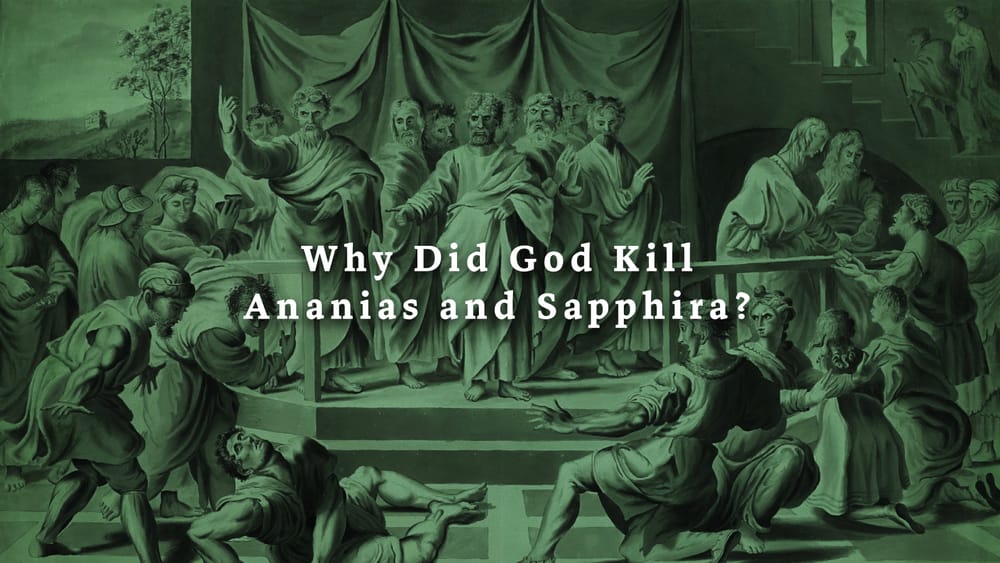
The text never says God killed them.
Most of us, the first time we hear this story, assume He did, and so do most sermons on Acts 5. Ananias and Sapphira voluntarily sell a piece of property, hand over part of the price while pretending it's the whole, and within three hours both of them are dead. Our imaginations fill in the blanks. God must have struck them down. Preachers have gotten a lot of mileage out of that assumption. Nothing moves a stewardship campaign like implied smiting.
But Luke says something more simple. Or perhaps strange: Ananias heard Peter's words, fell down, and died (Acts 5:5). No angel, no "the hand of the Lord was against him." It's not even the divine passive, a grammatical move biblical writers make when they want God's involvement implied without being named ("he was struck"). Ananias isn't struck at all. He hears, and the hearing seems to kill him.
It’s not like Luke doesn’t know how to write the other kind of death. Seven chapters later, Herod Agrippa sits on his throne in a silver robe and accepts the crowd's shout that his is the voice of a god, "and immediately an angel of the Lord struck him down... and he was eaten by worms and breathed his last" (Acts 12:23). That's a complete coroner's report: agent, mechanism, worms. When Luke wants you to know God's messenger did the killing, he’s fine telling you. But with Ananias and Sapphira he withholds the agent. That's either sloppy writing or deliberate silence. And Luke is not a sloppy writer.
Then the young men get up, wrap the body, carry it out, and bury it (5:6). No stoning, no corpse left exposed as a warning. Ananias is treated like a dead brother, not like contamination.
Sapphira, meanwhile, walks in three hours later having missed both her husband's death and his funeral, because apparently no one thought to tell her (5:7). Hell of a marriage they must have. Peter asks her to confirm the price. She confirms it, and it goes for her the way it went for him. The same young men are still on shift (5:10). Busy shovel day.
The Achan story, inside out
Luke gives us a signpost in the vocabulary. The verb translated "kept back" (ἐνοσφίσατο, 5:2) is the same verb the Greek Old Testament uses for Achan, the Israelite who "kept back" some of the devoted plunder from Jericho (ἐνοσφίσαντο, Joshua 7:1 LXX). Readers who knew their Scriptures in Greek would have heard the echo. Then they would have noticed everything that doesn't match.
• Achan sins alone, in secret, and all Israel suffers for it—thirty-six men die in battle at Ai before anyone knows why.
◦ Ananias and Sapphira conspire together (Peter's word in 5:9 is συνεφωνήθη, "you agreed together"), and the consequence stops with the two of them.
• Achan is stoned along with his sons, his daughters, and his livestock (whose position on the plunder went unrecorded), and the whole pile is burned.
◦ Ananias and Sapphira are buried, each with care, side by side.
• In Joshua, guilt spreads outward like contagion and the community purges it with collective violence.
◦ In Acts, the community never lifts a hand.
Read that way, Acts 5 is the Achan story turned inside out. The same sin, hoarding what belonged to the common life, with a different consequence. There’s no guilt spreading to the family, no violence from the community. Whatever killed Ananias and Sapphira, it wasn't Israel's old machinery of purge and burn (which they say was commanded by God), and Luke seems to be at pains to say so.
Even their names sit in the story like an epitaph. Ananias is the Greek form of Hananiah, "Yahweh is gracious." Sapphira is Aramaic for "beautiful." The names announce what this community was supposed to be. The lie hollowed both out.
Death by withholding
Peter's question to Ananias shows us the theology of the story. "While it remained unsold, did it not remain your own? And after it was sold, was it not at your disposal?" (5:4). No one forced the sale. No one demanded the full price. There was no pledge drive, no giving thermometer propped up in Solomon's Portico. Barnabas, one chapter earlier, sells a field and lays the whole amount at the apostles' feet, and nothing suggests he was forced to. The sin was the performance of it all: wanting the reputation of total generosity while running a private hedge fund against the community.
Luke has just told us "there was not a needy person among them" (4:34), a line lifted from Deuteronomy 15:4, where God describes what Israel's economy would look like if the sabbath-year commands were ever kept. Luke is claiming the promise came true, in Jerusalem, at least for a while, among a few thousand people who held everything in common. That is the fragile miracle Ananias and Sapphira punctured.
That opens a darker possibility than divine execution. In a community where every need is met because nothing is withheld, withholding is the lethal act. It kills the commons, and Luke may be saying it kills the withholder too. Nothing needs to be imposed from outside. God doesn't need to smite. The act of holding back, dressed up as a generous gift, is death itself.
I wonder about the fear, too. "Great fear seized the whole church" (5:11), and we assume terror of a God who kills liars. But watch how scarcity moves through a group. If they held something back, do I need to hold something back? One hedge licenses the next. Fear like that spreads through a commons like wildfire, and at the end of it there are needy people among them again. Luke follows the fear, by the way, with the strangest church-growth report in the Bible: none of the rest dared join them, and yet believers kept getting added in greater numbers than ever (5:13–14). Fear did not hurt attendance.
The god we assume
A question worth asking is the one beneath the original question. If we ask “Why did God kill Ananias and Sapphira?” then we’ve already decided who the killer was, although the text never said it. Something in us reaches for the smiting God before the text asks us to.
I read Acts 5 and see the God who is exactly like Jesus: who let his betrayer kiss him, who healed the ear Peter's sword took off. If a reading of this story requires a God less Christlike than Jesus, the problem sits with the reading.
Ananias heard what he had done, spoken plainly, in front of the people he had done it to. Then he fell. The young men stood up, wrapped the body of a man named "God is gracious," and carried him out to a grave the community dug for him—no stones in anyone's hands.