Some thoughts on Christopher Nolan's The Odyssey. Mild spoilers for a 3,000-year-old poem and the film built on it.
I saw Nolan's The Odyssey this week. What an apt parable for America's inability to welcome the stranger — and for the horrors of war.
The Law of Zeus
The film hangs its moral architecture on what it calls "the law of Zeus": protect the stranger, welcome the guest, treat others as you would have them treat you. I walked out wondering how much of that was Homer and how much was Nolan sneaking the Sermon on the Mount into the Bronze Age. I've read Homer throughout my education, but I'm not enough of a classicist to answer from memory. So I went digging.
The hospitality half turns out to be the most Homeric thing in the movie. The Greeks called it xenia — guest-friendship — and one of Zeus's cultic titles was Zeus Xenios, Zeus of Strangers. The princess Nausicaa says it outright: "all strangers and beggars are from Zeus" (Odyssey 6.207–208), and Eumaeus the swineherd repeats her line word for word eight books later. The whole epic is a catalogue of hospitality kept and hospitality broken. Nestor, Menelaus, and the Phaeacians host well; Polyphemus eats his guests; the suitors devour their host's estate, and Homer frames their slaughter as Zeus's judgment on broken guest-law. Book 17 even warns that the gods walk the earth disguised as strangers, watching how we treat them — the same trope the book of Hebrews borrows when it says some have entertained angels without knowing it (Hebrews 13:2).
The Trojan Horse is the film's boldest piece of interpretation. History files the horse under brilliant tactics. Nolan reframes it as the original crime: a false gift, hospitality weaponized, guests who came to kill. Odysseus's decade of suffering becomes the consequence of breaking the very law he'll spend the rest of the story depending on. Homer never says that outright, but it's a fair extension of his ethics, and it lets the film indict its war hero without a single speech telling us to.
I can't tell you every way the film reshapes Odysseus's character; I'll leave that to the classicists. But a story that old is the kind you're allowed to adapt. Wooden fidelity to the original would be pointless.
Matthew 7:12 in a Chiton
The Golden Rule phrasing is another matter. "Treat others as you would have them treat you" is Matthew 7:12, and putting it in Zeus's mouth smooths an ancient reciprocity ethic into something church kids already know. Homeric xenia ran on honor, obligation, and the live possibility that your guest was a god in disguise. You fed the stranger because Zeus was watching, and because guest-friendship built alliances your grandchildren could still call on. The Greeks had cousins of the rule — Calypso promises to treat Odysseus as she'd want treating in his place (5.188–190), and Isocrates taught "don't do to others what angers you" centuries before Jesus — but the positive, universal command belongs to the Gospels.
Which makes the film a case study in Tom Holland's Dominion — the historian, though the actor is also in this movie, and I'll get to him. Holland's thesis is that the West is so soaked in Christian moral instincts we can't tell an ancient story without them. Mercy for the enemy, dignity for the beggar, homecoming as grace. An ancient Greek would find stretches of this film unintelligible. A modern audience doesn't even register the anachronism.
And a word for the culture warriors sniffing this film for wokeness: if stranger-love is woke, then the anti-woke crowd has managed to adopt an ethic worse than what Greek pagans figured out 3,000 years ago. Ew.
The Film Itself
It's heavy. Nolan depicts violence — including sexual violence — in a way that's visceral without being gory or exploitative. You understand what happened without the camera lingering on it. More directors should learn that difference.
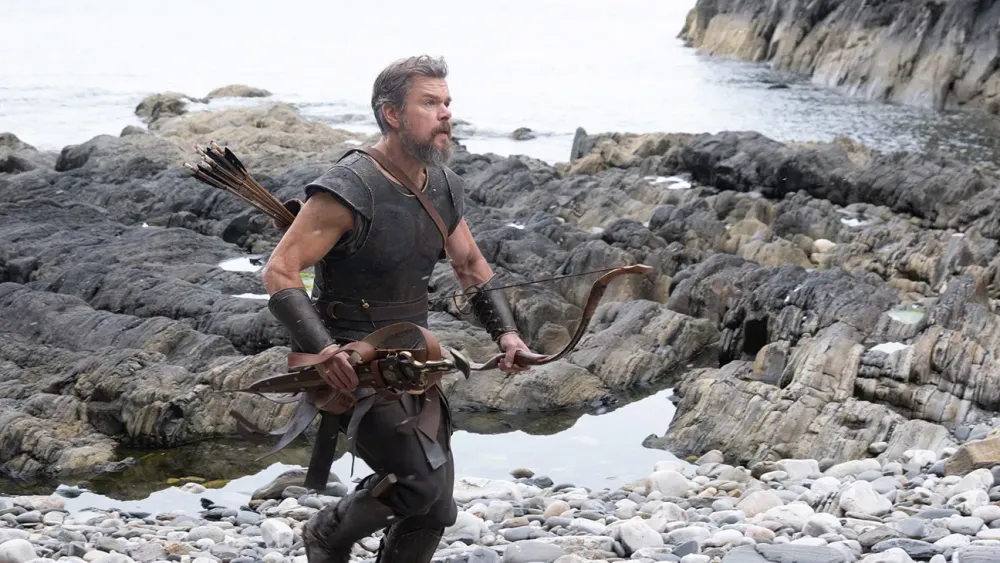
Circe could have gone wrong in two directions, cardboard witch or girlboss anachronism. The film threads it; she's compelling without being flattened into a modern feminist icon. The rest of the cast disappears into their roles, which I mean as a compliment — I stopped seeing famous people. Tom Holland was the exception. I never quite forgot I was watching Peter Parker, and that's the cost of his fame, not a flaw in his performance.
And it's gorgeous. I know better than to believe the "all practical effects" marketing — there's plenty of VFX — but the effects are invisible in a way that keeps the whole thing feeling real. I enjoy Marvel spectacle as much as anyone. Nothing beats this. As for the complaining about American accents and the occasional f-bomb: the idea that a serious film requires British accents is stupid. Homer's Greeks didn't speak the King's English either.
The homecoming — mild spoiler for a poem your great-great-grandparents could have spoiled for you — lands with what Tolkien called eucatastrophe: the sudden joyous turn, grace breaking in after everything has gone too far to fix. I can't remember the last time a film's ending felt that cathartic.
I haven't made it to an IMAX screening yet; I'm hoping to fix that here in DC. See it on the biggest screen you can find.