Belonging has always been tricky for me. I was a foster kid who got adopted as a teenager, and figuring out where I fit, and who I was safe with, has never come easy. One of the stranger places that shows up is my relationship with denominations. I've never found a home in one.
After I moved in with the Parrotts, I started going to their church, which was part of the Missionary Church denomination. I went to Bethel College, the denomination's school, and graduated in 2009. The obvious path was to get credentialed with the Missionary Church.
It took a couple of tries. At my first meeting with the credentialing board, I ended up correcting them on what the denomination's own constitution said about some of their beliefs. Afterward, the district superintendent pulled me aside and told me I needed to cool my jets a little. Which is, you know, par for the course for me.
I did get the credential, on the condition that I land a job in the Missionary Church. That never happened. I had the good fortune of graduating into the Great Recession, and nobody was hiring. I ended up as a worship leader at a church in Iowa that belonged to the Reformed Church in America. The pastor there had no problem with an Arminian-Wesleyan type like me, but there was no way I was getting ordained in a Calvinist denomination. I fit in well with the church. The denomination and I were predestined not to work out.
I went to seminary at Asbury, which is Wesleyan and full of Methodists. I like the Methodists quite a bit. But several of my peers warned me away from the United Methodist Church at the time, partly because the ordination process is pretty byzantine, and partly because the UMC was in the throes of what would become a split over human sexuality.
I've long admired the Episcopalians and the wider Anglican Communion, too. But there's no workable way to get ordained in that tradition without first belonging to one of their churches, and I was busy serving somebody else's.
My career hasn't required ordination, which has been a mercy. I went from worship and discipleship pastor in Iowa to pastoring The Table Church here in DC, which is non-denominational and gave me a local ordination.
I've never been comfortable with that. Without getting too far into the weeds of ecclesiology, I feel a strong pull toward traditions that hold to apostolic succession and have a small-c catholic sense of the universal church. By which I don't mean Roman Catholic. I mean the conviction that every church is, in the end, connected to every other.
I've said for years that I value this, and yet I haven't lived it out. I find the non-denominational movement pretty problematic. And yet here I am, ordained by and pastoring a non-denominational church.
Some of this is the plain weirdness of denominations, where joining means signing your name on the dotted line under a list of beliefs. And I've moved around a lot. I was baptized Roman Catholic, then Missouri Synod Lutheran, then Missionary Church. I worked in a Reformed church for ten years and went to a Methodist seminary. One of my values is to keep evolving, and I hate stagnation, and it's only been in the past six to eight years that my theology has felt fairly settled.
My theological penchants, however, aren’t welcome in every denomination, or in every district of a denomination. I'm grateful I had room to let them grow, first in Iowa with no ordination at all and then at The Table with a local one.
The mainline denominations have great things going on. For decades they've shown, in public, that fundamentalism and white evangelicalism don't get to define what Christianity is or have the final say on it. But they're old and rickety, and they can get bogged down in institutionalism.
Over the past twenty years we've seen plenty of attempts at building new structures. Because I'm grumpy and a little cynical, I've looked at some of them askance. Is the right move always to start something new? Shouldn't we be joining what came before?
There's also the fact that much of what's new has been built by white folks and centers whiteness, as if the Black church and Latino churches hadn't been doing the work of justice and inclusion for a long time already. Though some of those churches can be socially conservative in ways that shut out marginalized people too.
Wild Fig describes itself as "an emerging relational network for ministers and ministries looking for an alternative to traditional denominational structures."
Wild Fig found me because I was pontificating on Threads. I'd been going on about the need for better credentialing for pastors, the kind that makes sure we're trauma-competent and theologically grounded, and doing whatever is ours to do to create physical, emotional, and psychological safety for our congregations. One of the founders reached out. Hey, we're kind of doing something like that. Are you interested?
Their guiding values:
- Relationships. Love is our currency and we move at the speed of trust.
- Inclusion. God's table is wide and open to all, especially the marginalized and excluded.
- Humility. Leaning into our limits leads to wisdom.
- Mutuality. Collaboration and cooperation rather than command and control.
- Creativity. Imagination is the engine of renewal.
- Praxis. Loving practice binds us together rather than dogma.
And their collective commitment:
Grounded in our guiding principles, we commit to the shared, ongoing work of anti-racism, decolonization, de-centering whiteness, dismantling patriarchal structures, and fully welcoming and including all people regardless of age, race, ethnicity, disability, economic background, marital status, sex, gender identity, and sexual orientation.
I couldn't have said it better myself. It sounds a lot like what we've been up to at The Table.
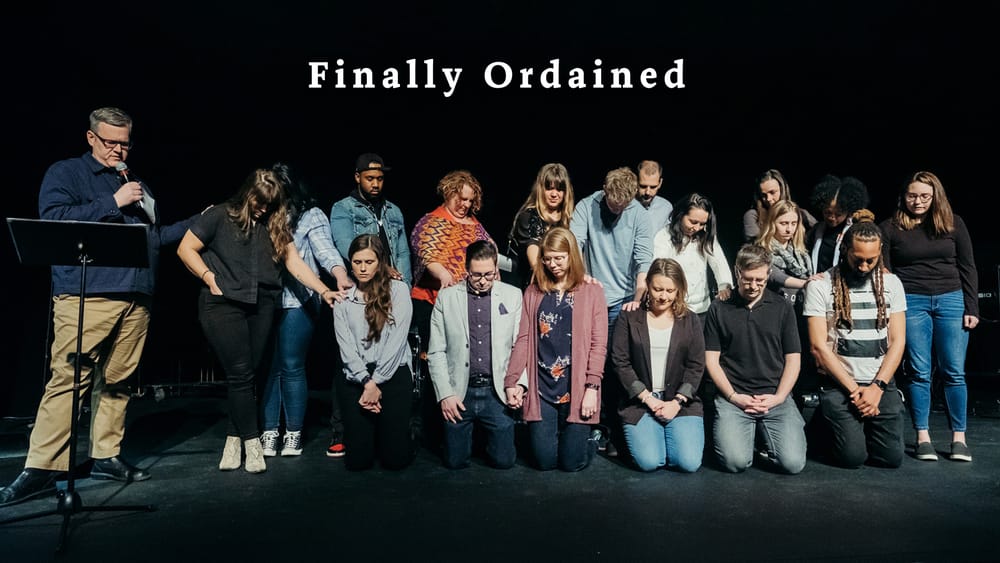
Tomorrow night I'll be among the inaugural group credentialed by Wild Fig. Twenty-eight of us will have hands laid on us and be ordained. It means more than I can say to finally put some action behind my values, to join up with something bigger than myself and find a sense of ecclesiological belonging. And to help midwife something new that I hope and pray will last beyond my lifetime. An expression of my faith centered on relationships and love, on Jesus and inclusion.