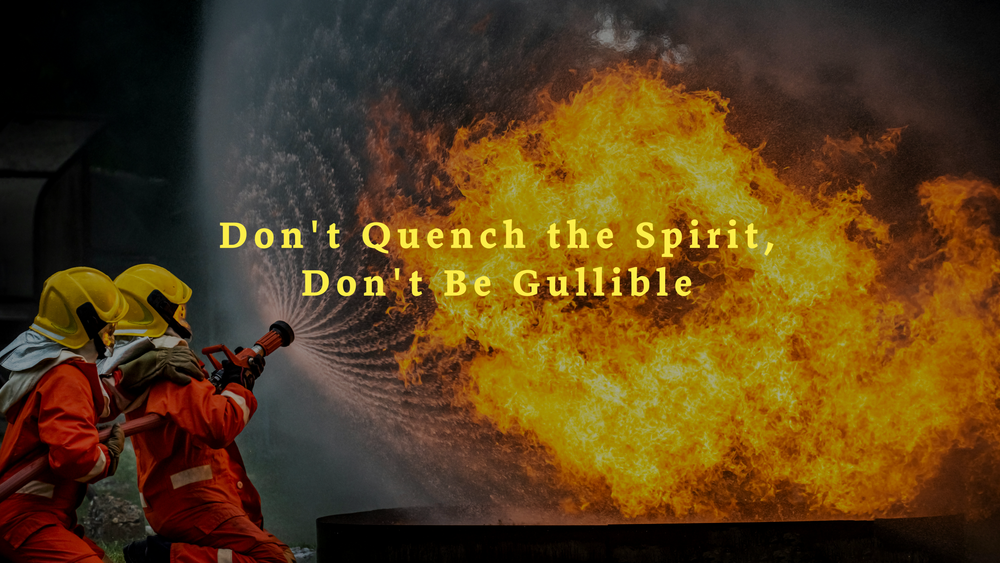
For a stretch of my teenage years, I belonged to what I can now comfortably call a charismatic cult. I don't know about you, but I have cast demons out of a barn. (The barn, to my knowledge, remains demon-free. You're welcome.) I have watched grown adults get slain in the Spirit and lie on the carpet like unplugged appliances. I have spoken in tongues. I have received words of knowledge from strangers whether I liked it or not.
The "whether I liked it or not" part is important. Years later, at a different and much tamer church, someone stopped me in the sanctuary. They had something the Lord wanted me to know. I was excited—I braced for some encouragement. The Lord's message, it turned out, was that women preachers are evil and unbiblical. Oh.
All of which is to say: when I tell you I understand the urge to quench the Spirit, know that I own a large bucket filled with water, my name engraved on it.
Which is why 1 Thessalonians 5 won't leave me alone. Near the end of the letter, Paul fires off a string of one-line commands. Rejoice always. Pray without ceasing. Give thanks in everything. And then this, packed into four verses:
Do not quench the Spirit.
Do not despise the words of prophets,
but test everything;
hold fast to what is good;
abstain from every form of evil.
(1 Thessalonians 5:19–22)
Two of those commands sound charismatic, two sound skeptical. Paul refuses to choose, and he won't let his church choose either.
I want to show you how he pulls that off, and then hand you four questions for testing any "word from God" that crosses your path: Does it look like Jesus? What does it produce? Who pays for it? And has anyone besides the prophet weighed it? Hold onto those. We'll come back.
Somebody Was Holding a Bucket
"Do not quench the Spirit." The verb Paul uses is the ordinary word for putting out a fire, the same one Matthew uses for lamps sputtering at midnight. The Spirit kept showing up as fire in the early church's imagination, tongues of flame and all, so Paul's image is blunt: someone in Thessalonica was dousing the flame.
The commands in the epistles tell on their audience. You don't write "stop putting out the fire" to people who aren't holding buckets. And the next line tells us why they were: they had started despising prophecy. "Despise" is the right translation of a strong word; it means to write something off as nothing. Not caution, but outright contempt. The eye-roll that arrives before the word gets a chance.
Why would a young church land there? The same reason anyone does. Somebody must have gotten burned.
The Bucket Brigade
If you grew up anywhere near my old world, you know how it happens. "God told me" did a lot of dirty work. It ended arguments. It arranged marriages. It explained why the offering needed to double, and why the prophecy about the election was still true after the votes were counted, if you understood it correctly, which, well, obviously, you didn't.
The exit ramp from that world is skepticism, and skepticism feels like health. If the Spirit was the cover story for what hurt you, quenching the Spirit looks like safety. I spent years walking around with a fire marshal's clipboard, citing violations. Plenty of us did. Nothing supernatural survived the inspection, because the inspection was never going to approve anything.
Paul won't let me retire there. He also won't let me go back to swallowing everything whole. He threads the needle with a single verb.
Test Everything
"Test everything." Paul's word is dokimazete, and it comes from the world of money-changing. It's what you do to a coin to find out whether it's what it claims to be. Weigh it on a scale, scratch it on a touchstone, or, when in doubt, bite it.
Picture the money-changer's booth. A merchant who refused every coin went out of business. A merchant who accepted every coin went out of business faster. The job was never solely suspicion, and it was never solely trust. The job was telling the difference.
That's the posture Paul wants. Not the bucket brigade or the church where every goosebump is canonized. Instead a community that can hold a "word from the Lord" up to the light and check the weight.
One more thing before the four questions. Every verb in this passage is plural. Quench, despise, test, hold fast, abstain: Paul is talking to a congregation, not an individual. Testing is a team sport. He says it outright to the Corinthians: let the prophets speak, "and let the others weigh what is said" (1 Corinthians 14:29). No lone mystic whose word is exempt from the body. No lone skeptic whose veto outranks it.
The Four Questions
Paul doesn't list criteria in 1 Thessalonians. But he shows his hand in 1 Corinthians, where his longest discussion of prophecy gets interrupted by a love poem. Chapter 13 is not a wedding reading that wandered into the wrong letter. It's the test, parked in the middle of the charismatic material on purpose. Whatever doesn't look like love is counterfeit, no matter how impressive the letterhead.
From there, the questions follow.
1) Does it look like Jesus?
The Spirit's job description, according to Jesus, is to remind the church of Jesus (John 14:26). A real word will look like him: self-giving, gentle with the bruised, unimpressed by power. My sanctuary prophecy failed this one. There was no cross in it. Just a gate, and someone enjoying the gatekeeping.
2) What does it produce?
Jesus gave this one away for free: you know them by their fruits. Real words produce love, courage, freedom, repair. Counterfeits produce anxiety, control, and a suspicious amount of revenue for the prophet.
3) Who pays for it?
A word from God does not bill the vulnerable. If the prophecy asks the poor to give more and the powerful to change nothing, the coin is countefeit.
4) Has the community weighed it?
Not "did it give me chills." Chills are cheap; I've gotten them from key changes in a Taylor Swift song. The question is whether the community, including the people the word would cost something, recognized God in it.
Notice that the test is not merely "does it feel good." Plenty of counterfeit feels wonderful; ask anyone who's been love-bombed. And some true words land hard. The question is whether it is liberating and life-giving. Not only for me but for others. Even for my enemies. A word that gives me life by draining someone else is not from the Spirit whose fire fell on all flesh.
Hold Fast
The commands don't end at testing. "Hold fast to what is good; abstain from every form of evil." The coin-testing has two outcomes, and both require action. Counterfeit gets refused. Gold gets kept.
(A quick aside for my purity-culture alumni: the KJV's "abstain from all appearance of evil," the verse once deployed to keep you from being seen near a liquor store or a dance floor, is a mistranslation. The word translated "appearance" means form or kind, not optics. Paul wants you to refuse evil in all its varieties, not manage the neighbors' impressions of you.)
Testing has a goal. Somewhere in the pile of words and impressions and goosebumps, there is real gold, and the community that never finds any has failed the test as thoroughly as the community that swallows everything.
I never did go back to check on that barn. But I haven't given up on fire. Quenching the Spirit was never within our power anyway. The flame doesn't die when we douse it; it moves on to people who will have it, and the loss is ours. And permanent skepticism, which feels like intelligence from the inside, carries its own risk: you can be standing there with your clipboard, citing violations, while the real thing passes through the room. A church that only looks for fire gets burned. A church that only tests misses the visitation. Paul asks for the harder thing, the one we keep collapsing out of in both directions: keep the fire, and keep the scales.