
November 8–14, 2026 · Pentecost 24
This week's readings
- Sunday, November 8 (Pentecost 24) · 2 Kings 5:1–15a · Elisha Heals Naaman
- Monday, November 9 · 2 Kings 6:1–7 · Elisha and the Axe Head
- Tuesday, November 10 · 2 Kings 16:1–20 · The Reign of Ahaz
- Wednesday, November 11 · Isaiah 7:1–17 · Isaiah's Message to Ahaz
- Thursday, November 12 · Psalm 46:1–11 · A Song of Hope for the City
- Friday, November 13 · Isaiah 11:1–9 · A Promised Hope, part 1
- Saturday, November 14 · Isaiah 11:10–16 · A Promised Hope, part 2
2 Kings 5:18–19a
“But may the LORD forgive your servant for this one thing: When my master comes into Rimmon’s temple to bow down there and is leaning on my arm, I must also bow down in Rimmon’s temple. When I bow down in Rimmon’s temple, may the LORD forgive your servant for doing that.”
Elisha said to him, “Go in peace.”
(2 Kings 5:18–19a CEB)
Notes
Sunday's reading stops at verse 15, with Naaman fresh out of the Jordan, his skin like a child's, telling Elisha, "Now I know that there is no God in all the earth except in Israel." But you just gotta keep reading! A few verses past where the lectionary stops, the story takes a turn I adore.
Naaman wants to take Israel's God home with him, so he asks for two mule-loads of Israelite dirt to worship YHWH on back in Damascus (v. 17). Then he brings up a problem with his job. Naaman commands the king of Aram's army, and when the king goes to worship in the temple of Rimmon, he leans on Naaman's arm. When the king bows, Naaman bows. (Rimmon is the Aramean storm god Hadad, under a title that probably meant "the thunderer." In Hebrew, though, רִמּוֹן (rimmon) means pomegranate. I'd like to think the storyteller is having a little fun. Is your favorite WWE wrestler The Thunderer…or The Pomegranate?)
Verse 18 uses the verb הִשְׁתַּחֲוָה (hishtahavah), "bow down," three times. That's the verb of the Ten Commandments: "You shall not bow down to them or worship them" (Exodus 20:5). Naaman is asking ahead of time for permission to do the thing Sinai forbids, and he wraps the whole request in forgiveness: יִסְלַח (yislah), "may YHWH forgive," at the start of the verse and again at the end. The Hebrew Bible never uses that verb for anyone but God.
Elisha answers in two Hebrew words: לֵךְ לְשָׁלוֹם (lekh leshalom), "Go in peace." That's the whole answer.
Compare that to last week's reading from 1 Kings 11. Solomon built high places for Chemosh and Molech on the mountain east of Jerusalem (1 Kings 11:7), and the narrator says his heart turned after other gods. A king put the resources of the state behind other gods' altars. Naaman's heart has turned the other way, toward YHWH, far enough that he's hauling dirt home, while his body still stands in Rimmon's house holding up his boss. Elisha can tell the difference.
I once counseled the Christian wife of a Muslim man. She was, of course, invited to join in the rituals of her husband's family and her husband's faith. Was she pissing God off by doing so? I don't think so. Respecting the faith of another religious tradition, and even participating in its rituals, is not the same as idolatry or syncretism.
I think Christians are far too superstitious. By which I mean a lot of us carry around a fear that if we do the religious equivalent of walking under a ladder, God will have no choice but to punish us. But God just doesn’t work like that.
This reminds me of a scene near the end of C. S. Lewis's The Last Battle. Emeth, a young Calormene officer, has served Tash all his life. When he meets Aslan, he falls at the Lion's feet expecting to die. Instead Aslan welcomes him and tells him that the true and good service he did in Tash's name, Aslan counts as done for him. Aslan knew Emeth had been worshiping Tash because he was faithful to the One True God—who else is there? (Lewis picked the name on purpose: אֱמֶת (emet) is Hebrew for truth, or faithfulness…and Calormen is a gross caricature of Islam, so we might need to spit out the bones on that one 😬)
Paul says something similar in Romans 2. He imagines Gentiles who never had the Torah doing what it requires anyway, because they carry "the work of the law written on their hearts" (2:14–15). People unaware of YHWH can still be faithful to a God they don't know. In Athens, Paul tells the crowd about an altar he passed, inscribed ἀγνώστῳ θεῷ (agnosto theo), "to an unknown god," and says, "What you worship without knowing it, this I proclaim to you" (Acts 17:23). The verb there, εὐσεβεῖτε (eusebeite), means to revere, to be devout. Paul gives the Athenians credit for real devotion and then tells them who it's been reaching.
Jesus picked Naaman's story for his first sermon in Luke. Back home in Nazareth, he reminds the synagogue that Israel had plenty of people with skin disease in Elisha's day, and the only one cleansed was Naaman the Syrian (Luke 4:27). His hometown tried to throw him off a cliff for it. For being too generous with his assumptions of who God counted as in or out.
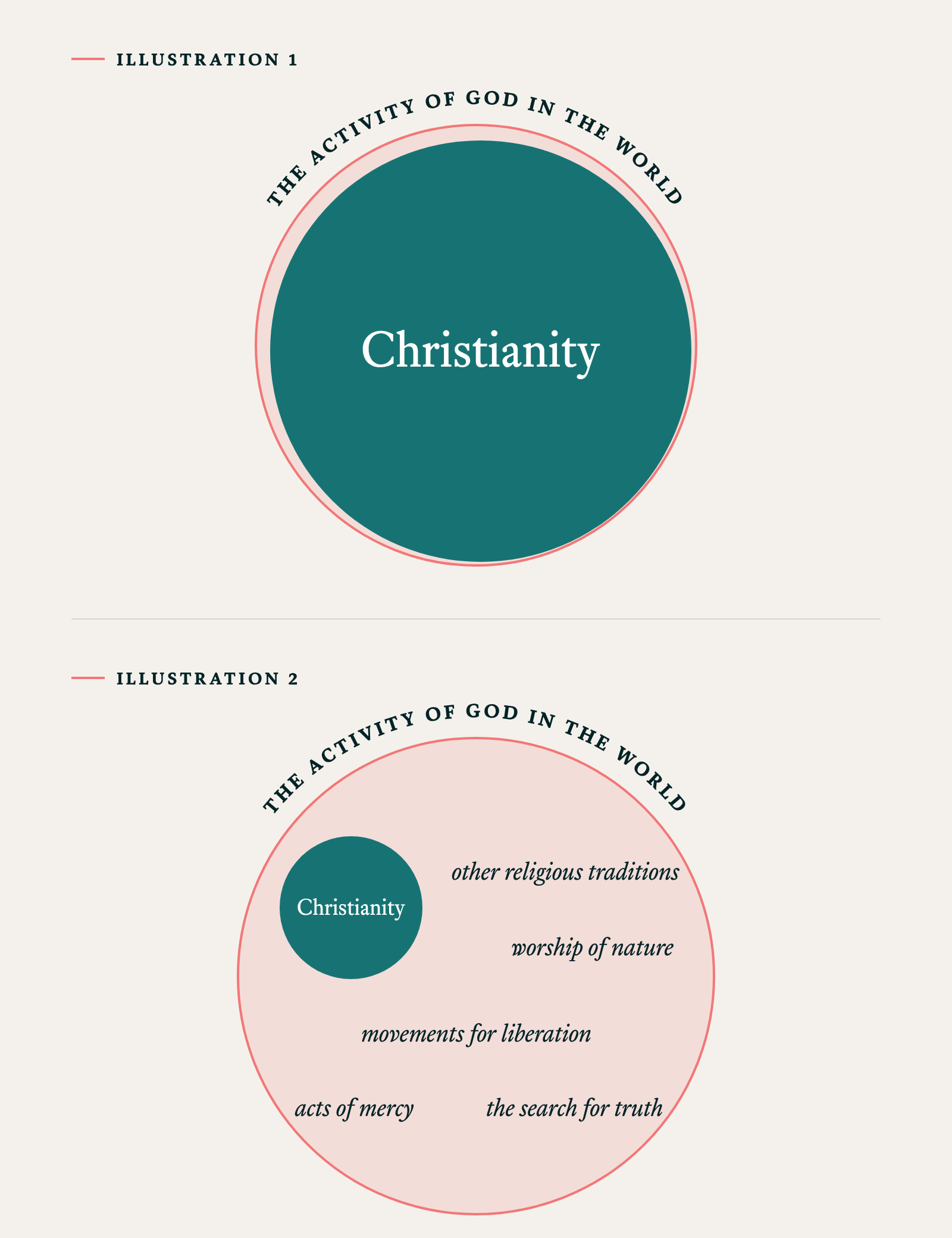
Picture a circle labeled The Activity of God in the World. A lot of us were taught to draw a second circle, labeled Christianity, right on top of it, about the same size: wherever God is at work, there's Christianity, and wherever Christianity isn't, God isn't either. I see it more like the second picture. Christianity is a small circle, and the activity of God in the world includes far more: other religious traditions, worship of nature, political movements for liberation, and plenty more we'll never think to label.
All that to say, I love Elisha's response. Go in peace. It's Paul's response too, in the passage where he deals with the same situation I described. In 1 Corinthians 7, Paul tells believers married to unbelievers to stay if their spouse is willing, because "the unbelieving husband has been made holy in his wife" (7:14). Paul assumes holiness is the contagious thing in a mixed household. Our superstition assumes the opposite. A verse later he names the principle underneath all of it: "God has called you in peace" (7:15).
God desires our peace. That's how we make these decisions, with that value in mind.
Questions for reflection
Naaman uses the Ten Commandments' verb for bowing three times in one breath, and Elisha answers with two words. Why do you think the storyteller lets "Go in peace" stand without explanation?
What were you taught was the religious equivalent of walking under a ladder? How does that fear shape the way you show up for friends and family of other faiths?